If you passed 12th with Physics, Chemistry and Biology or Maths, you can start a pharmacy course after 12th right away — a 4-year B.Pharm degree or a 2-year D.Pharm diploma — with no NEET and no KCET. Admission is direct and merit-based on your 12th marks at PCI-approved colleges like Vidya Siri College of Pharmacy, Bangalore.
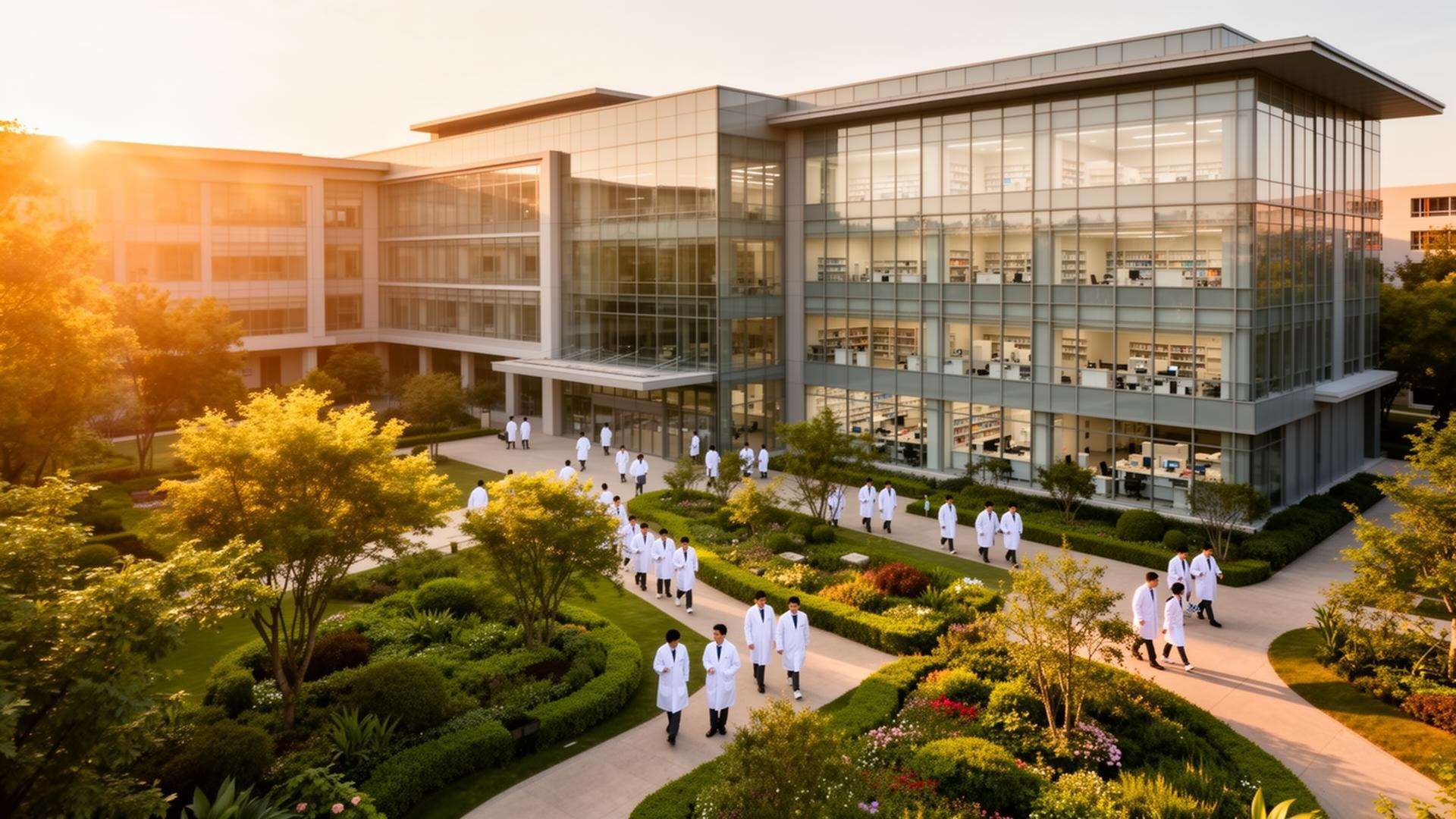
Let me guess. You just finished 12th, the science stream chewed up two years of your life, and everyone around you is chanting the same three words: NEET, engineering, or drop. Meanwhile you actually like the idea of medicines, chemistry, and helping patients — you just don’t want to gamble another year on a brutal entrance exam.
Get the 2026-27 Admission Brochure
Fees, eligibility, placement details, campus photos — all in one PDF. WhatsApp us to get it instantly.
Here’s the part nobody tells you clearly. A pharmacy course after 12th gives you a real, respected place inside the healthcare system — without NEET, without KCET, and without waiting. I’ve watched hundreds of students walk through this exact crossroads, and the ones who chose pharmacy rarely look back.
This guide is the honest version. No fluff, no sugar-coating — just what the two pharmacy pathways actually are, who they suit, what they cost, what you’ll earn, and how to pick a college you won’t regret. Grab a coffee. This is the one page you’ll want to send your parents.
RGUHS Affiliated
No NEET Required
Direct Admission
In This Guide
- What Pharmacy Really Is — Beyond Just Dispensing
- Your Two Roads: B.Pharm and D.Pharm
- Can You Actually Apply? The Eligibility Checklist
- The No-NEET Truth Nobody Explains Properly
- How to Choose a College You Won’t Regret
- Where This Career Can Take You
- What You’ll Actually Earn
- How Admission Works at VSCP
- About Vidya Siri College of Pharmacy
- Questions Students & Parents Actually Ask
What Pharmacy Really Is — Beyond Just Dispensing
Ask ten people what a pharmacist does, and nine will say “the person behind the medical shop counter.” Fair. But that’s like saying a chef just reheats food.
Pharmacy is the science of medicines — how they’re designed, made, tested, dosed, and safely handed to a human being who needs them. It lives right at the meeting point of chemistry, biology, and patient care. When a cancer drug reaches a patient at exactly the right strength, a pharmacist stood somewhere in that chain making sure of it.
And that chain is huge. A pharmacy background can put you in any of these worlds:
- Drug discovery & research — building new molecules and proving they work
- Manufacturing & quality control — keeping factory production safe and compliant
- Community & retail pharmacy — dispensing and counselling patients face to face
- Hospital pharmacy — managing drug supply and advising doctors on the ward
- Regulatory affairs — getting new drugs legally approved
- Clinical research — running the trials that prove a drug is safe
Now the number that should make you sit up. India’s pharmaceutical industry is the third-largest on Earth by volume, supplying medicines to more than 200 countries. It’s often called “the pharmacy of the world” — and it needs a steady stream of trained pharmacists to keep running.
So when you choose a pharmacy course after 12th, you’re not betting on a fashionable field. You’re stepping into an industry with genuine, boring, beautiful stability. Want the deeper breakdown? Here’s an honest look at whether pharmacy is a good career.
Your Two Roads: B.Pharm and D.Pharm
After 12th, there are two proper, PCI-regulated pharmacy qualifications. Not five, not ten — two. That’s actually good news, because it makes the decision clean.
B.Pharm — Bachelor of Pharmacy (4 Years)
B.Pharm is the full degree. Four years, eight semesters, regulated by the Pharmacy Council of India. Think of it as the main highway — it goes the furthest and connects to the most exits: research, regulatory jobs, industry roles, government posts, and postgraduate study.
What you’ll study: Pharmaceutical Chemistry, Pharmacology, Pharmacognosy, Pharmaceutics, Pharmaceutical Analysis, Biopharmaceutics, Hospital & Clinical Pharmacy, and Pharmaceutical Management — with lab work baked into every single semester. If you’re curious about the exact subject-by-subject map, the RGUHS B.Pharm syllabus lays it out.
Who it suits: You, if you want long-term growth, you’re open to research or an M.Pharm / Pharm.D later, or you simply want the qualification that keeps the most doors open. The scope of B.Pharm in India is genuinely wide once the degree is in your hand.
D.Pharm — Diploma in Pharmacy (2 Years)
D.Pharm is the fast lane. Two years, also PCI-regulated, and it gets you working sooner. Finish it, register with your State Pharmacy Council, and you can legally run a retail pharmacy of your own. For a lot of families, that last sentence is the whole reason they’re reading this page.
What you’ll study: Pharmaceutics, Pharmaceutical Chemistry, Pharmacognosy, Pharmacology & Toxicology, Biochemistry & Clinical Pathology, Human Anatomy & Physiology, and Health Education — plus a mandatory 500-hour hands-on internship in year two. The full D.Pharm syllabus is worth a glance if you like knowing what you’re signing up for.
Who it suits: You, if you want a shorter and cheaper route to a real job, you’re planning to open a medical store, or you’re a first-generation student who needs a stable income sooner rather than later. And it’s not a dead end — there are solid careers after D.Pharm, and you can even lateral-entry into B.Pharm later.
B.Pharm vs D.Pharm at a Glance
| B.Pharm | D.Pharm | |
|---|---|---|
| Duration | 4 years | 2 years |
| Level | Bachelor’s degree | Diploma |
| Open your own pharmacy? | Yes | Yes |
| Best for | Industry, research, PG, govt jobs | Quick job, retail pharmacy |
| VSCP fees | Rs 70,000/year (Rs 2,80,000 total) | Rs 80,000 total (2 years) |
| Upgrade path | M.Pharm / Pharm.D | Lateral entry to B.Pharm |
Still torn between them? We wrote a full side-by-side on B.Pharm vs D.Pharm to help you decide with a clear head.
Not sure which course fits you?
Talk to our admissions team — 15 minutes on the phone can save you two years of second-guessing.
Can You Actually Apply? The Eligibility Checklist
Good news first: the bar is reasonable, and there’s no secret entrance exam hiding in the fine print. Here’s exactly what you need for a pharmacy course after 12th.
- You passed 12th (10+2) from a recognised board.
- Your subjects were Physics, Chemistry, and either Biology or Mathematics. Yes — PCB or PCM. Both work.
- Minimum marks: 45% aggregate for the general category, 40% for SC/ST candidates.
- Age: you should be 17 or above at the time of admission.
That’s the whole list. No NEET score. No KCET rank. If you scraped past with a Maths group and thought pharmacy was closed to you — it isn’t. PCM students are just as eligible as PCB students.
The No-NEET Truth Nobody Explains Properly
Let’s clear up the single biggest confusion in this whole subject, because it costs students entire years.
NEET is the entrance exam for MBBS and BDS — becoming a doctor or a dentist. It is not required for pharmacy. Neither is KCET. B.Pharm and D.Pharm admissions run on your 12th marks, full stop.
So the student who’s been told “no NEET, no medical field” has been handed a half-truth. Medicine as a doctor? Yes, NEET. Medicine as a pharmacist? No exam gate at all. You walk in on merit. Here’s the complete rundown on pharmacy admission without NEET in 2026 if you want it in black and white.
Think about what that actually means. No coaching-class debt. No one-mark-off heartbreak. No year lost to a repeat attempt. You take the marks you already earned and you start building a healthcare career this year.
How to Choose a College You Won’t Regret
Here’s where students get hurt — not by choosing pharmacy, but by choosing the wrong college for it. A pharmacy qualification is only as good as the approvals behind it. Run any college you’re considering through this checklist before you pay a rupee.
1. Is it PCI approved?
This is non-negotiable. PCI (Pharmacy Council of India) approval means the college meets national standards for curriculum, faculty, and infrastructure under the Pharmacy Act, 1948. Without it, your degree is decoration — you can’t register as a pharmacist and you can’t legally practise. Always verify. Here’s what a properly PCI-approved pharmacy college in Bangalore looks like.
2. Is it affiliated to a real university?
For pharmacy in Karnataka, that means RGUHS (Rajiv Gandhi University of Health Sciences). University affiliation is what makes your degree examinable, recognised, and portable.
3. What do the fees really total?
Ask for the four-year or two-year total, not just the first-year figure — that’s where surprises hide. Compare honestly. You can see VSCP’s full breakdown for B.Pharm fees in Bangalore and D.Pharm fees in Bangalore with nothing buried in the footnotes.
4. Do results and labs actually exist?
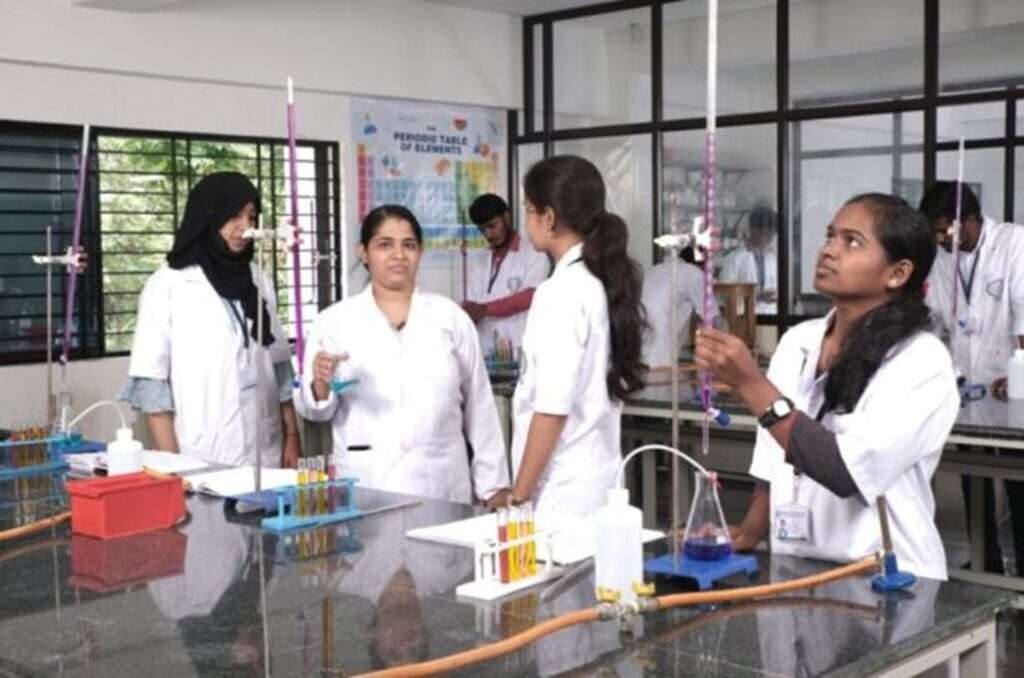
Anyone can print a brochure. Ask about recent university results and whether the labs are real, working, and used. At VSCP, the top RGUHS result stands at 91.16% — a number that comes from students in actual laboratories, not a marketing line.
Checklist looking good? Seats fill fast.
VSCP has 60 B.Pharm and 60 D.Pharm seats for 2026. Direct, merit-based admission — no exam, no waiting.
Where This Career Can Take You
A pharmacy course after 12th is not a single job — it’s a keyring. Each qualification unlocks a different set of doors, and you decide which ones to open.
After B.Pharm, students commonly move into:
- Hospital and clinical pharmacist roles
- Pharma industry jobs — production, quality assurance, quality control, R&D
- Drug inspector and regulatory affairs officer
- Medical representative and product management
- Clinical research associate
- Higher study — M.Pharm, Pharm.D, or an MBA to branch into pharma management
After D.Pharm, the popular paths are:
- Registered retail pharmacist — including running your own store
- Hospital dispensary and community pharmacy roles
- Pharmaceutical sales
- Lateral entry into B.Pharm to level up later
And don’t sleep on the public sector. There’s a whole ladder of stable, pensioned government jobs after pharmacy — drug inspectors, government hospital pharmacists, ESI and railway pharmacist posts, and more. For a lot of families, that security is the real prize.
What You’ll Actually Earn
Let’s talk money honestly — because a career you love still has to pay the bills.
Entry-level B.Pharm graduates in India typically start around Rs 3–6 lakh per year. Nothing dramatic on day one, and that’s normal for any fresh graduate. The real story is the slope: with three to five years of experience in a specialised lane like regulatory affairs or clinical research, Rs 8–15 lakh per year becomes very reachable.
D.Pharm earnings start lower but arrive sooner — and if you open your own pharmacy, your income stops being a salary and becomes a business you own. That ceiling is yours to raise.
| Stage | Typical annual range |
|---|---|
| B.Pharm, entry level | Rs 3–6 LPA |
| B.Pharm, 3–5 yrs (specialised) | Rs 8–15 LPA |
| D.Pharm, early career | Rs 2–4 LPA |
| Own retail pharmacy | Depends on you — it’s a business |
These are realistic ranges, not promises — your city, role, and skills all move the needle. For a fuller picture across roles and cities, here’s the detailed guide to pharmacy salary in India.
How Admission Works at VSCP
After all the theory, here’s the refreshingly simple part. Getting into Vidya Siri College of Pharmacy is not an obstacle course.
- Check you’re eligible — 12th with PCB or PCM, 45% aggregate (40% for SC/ST).
- Reach out — call, message, or drop by the Sarjapur Road campus.
- Submit your documents — 12th marks card, ID, photos, and category certificate if applicable.
- Get your merit-based seat — admission is decided on your 12th marks. No NEET, no KCET, no entrance exam.
- Confirm and enrol — pay the transparent fee and you’re in for the 2026 session.
The whole thing is built to be direct and merit-based, precisely because we think a clear 12th mark sheet tells us more than a stressful one-day exam ever could. Everything you need is on the pharmacy admission FAQ.
About Vidya Siri College of Pharmacy
Vidya Siri College of Pharmacy (VSCP) sits on Sarjapur Road in Bangalore — a genuinely convenient part of the city for students commuting from the IT corridor and beyond.
Two things anchor everything here: the college is PCI Approved and RGUHS Affiliated. That combination is exactly the checklist from earlier — national-standard approval plus a recognised university degree — already ticked off for you.
On the academic side, the top RGUHS result at VSCP stands at 91.16%. Fees are kept deliberately clear: B.Pharm is Rs 70,000 per year (Rs 2,80,000 across four years), and D.Pharm is Rs 80,000 total for the entire two-year programme. No riddles, no first-year-only teaser pricing.
With 60 seats in each programme, classes stay a manageable size — which means the labs, the faculty, and the attention are actually accessible to you rather than shared across a crowd. If you want to picture daily life here, this is what it’s like to study pharmacy at a PCI-approved college in Bangalore.
Your 2026 seat is one phone call away.
PCI approved. RGUHS affiliated. No NEET. Transparent fees. Direct merit-based admission on Sarjapur Road, Bangalore.
Questions Students & Parents Actually Ask
Is pharmacy a good career in 2026?
Yes. India’s pharmaceutical sector is the third-largest in the world by volume, and it isn’t slowing down. Rising healthcare demand, an ageing population, and global appetite for Indian generic medicines keep pulling in trained pharmacists — across hospital, industry, regulatory, quality, and research roles. It’s one of the more recession-resistant careers you can pick.
Can I do pharmacy without Biology?
Absolutely. PCI and RGUHS rules let students with Physics, Chemistry and Mathematics (PCM) apply for both B.Pharm and D.Pharm. Whether you took PCB or PCM, you’re eligible with 45% aggregate (40% for SC/ST). Don’t let the “you need Biology” myth stop you.
Is NEET required for pharmacy?
No. NEET is only for MBBS and BDS. B.Pharm and D.Pharm don’t need NEET at all. At VSCP in Bangalore, admission is direct and merit-based on your 12th PCB or PCM marks — no NEET, no KCET, no entrance exam.
What is the salary after B.Pharm?
Entry-level B.Pharm graduates usually earn around Rs 3–6 LPA. With three to five years of experience in a specialised role like regulatory affairs or clinical research, Rs 8–15 LPA is realistic. Growth in pharmacy rewards specialisation.
B.Pharm vs D.Pharm — which is better?
Neither is “better” in a vacuum — they suit different goals. B.Pharm (4 years) fits research, industry, PG study, and higher long-term salaries. D.Pharm (2 years) fits quick employment or opening your own pharmacy. And D.Pharm graduates can upgrade to B.Pharm through lateral entry, so it’s not a locked door.
Can I open my own pharmacy store after D.Pharm?
Yes. Once you complete D.Pharm and register with your State Pharmacy Council, you can legally open and run a retail pharmacy under the Drugs and Cosmetics Act, 1940. For many students, that independence is the whole appeal.
What is PCI approval and why does it matter?
PCI (Pharmacy Council of India) approval confirms the college meets national standards for curriculum, faculty, and infrastructure under the Pharmacy Act, 1948. Without it, you can’t register with a State Pharmacy Council or legally practise as a pharmacist. Always confirm PCI approval before enrolling — VSCP is PCI approved.
What are the fees for pharmacy at VSCP?
B.Pharm is Rs 70,000 per year, which comes to Rs 2,80,000 across the four-year degree. D.Pharm is Rs 80,000 total for the complete two-year diploma. Both figures are transparent — no hidden first-year-only pricing.
Is pharmacy better than nursing?
Both are respected healthcare careers with different scopes. Pharmacy leans toward stronger industry, corporate, and regulatory pathways with higher domestic salaries at senior levels. Nursing offers broader international migration options. The right pick depends on your aptitude and where you want your career to go.
Ready to take the next step on your pharmacy course after 12th? The team at Vidya Siri College of Pharmacy is on Sarjapur Road, Bangalore, and happy to walk you through eligibility, fees, and your 2026 seat. Call +91 98095 65758 — or start with the no-NEET admission guide.